September 11, 2026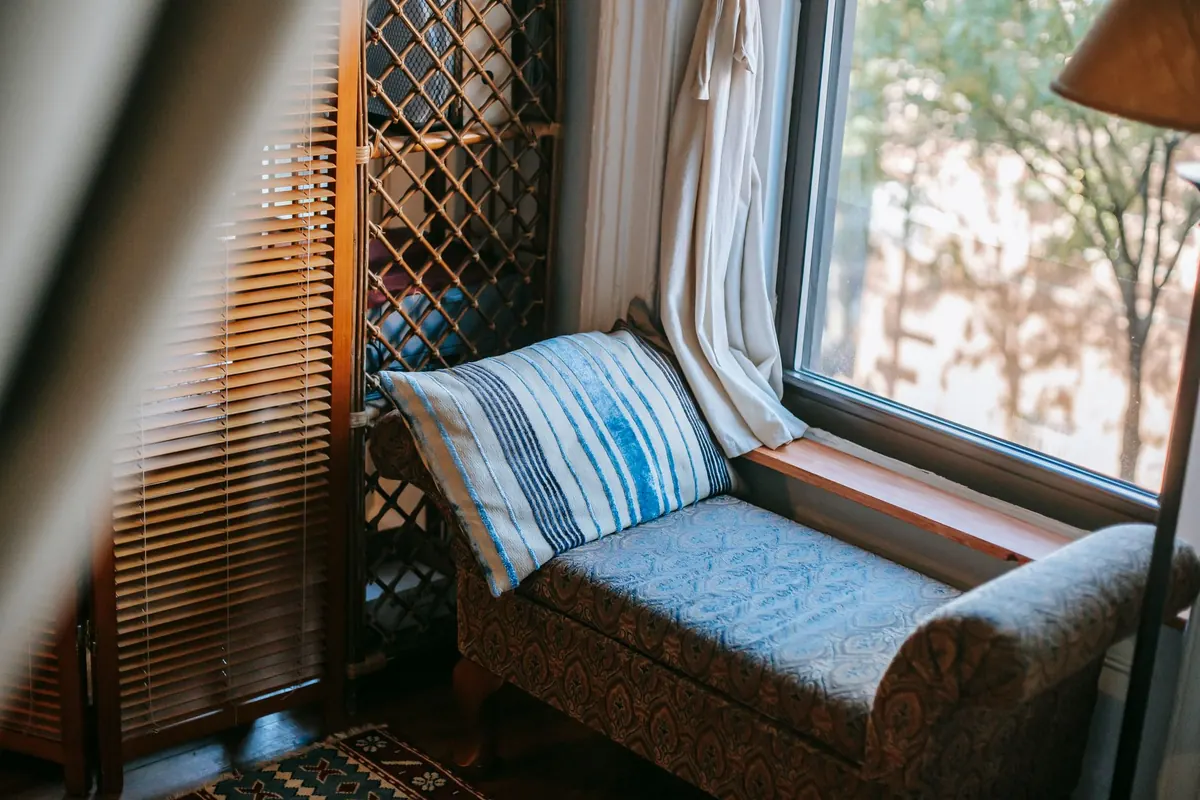
A cottage rarely hands you a spare room for a library. What it gives you instead are corners: the awkward gap beside a chimney breast, the alcove under a sloping ceiling, the strip of floor between the window and the door. Those are the places where reading nooks belong. With roughly four feet of width and an afternoon of rearranging, any of them can become the chair you drift toward after supper.
Start With the Spot, Not the Furniture
Before you shop for anything, walk the house and look for three things together: daylight, at least one solid wall, and a spot that isn't on the main path between kitchen and stairs. A nook you have to squeeze past with a laundry basket will stop being restful by the second week.
Good candidates in a small cottage tend to be:
- The corner beside a window, especially one with a deep sill or a low casement
- An alcove under the stairs, if headroom clears about four feet at the back
- A chimney-breast recess, which is often deeper than it looks
- The end of a hallway wide enough for a bench and a lamp
- The foot of a bed, if you use a slim bench rather than a full chair
Measure the floor space and write it down. Note where the radiators sit, which way the doors swing, and where the nearest plug socket is. If there's no socket, that changes your lighting plan from a table lamp to a rechargeable one, so it's worth knowing early.
Choose Seating That Earns Its Footprint
A reading chair should hold you comfortably for an hour, not just look charming. For most people that means a seat height of about 17 to 19 inches, a seat depth of 20 to 22 inches, and arms low enough to rest a book on without lifting your elbows. If the chair is deeper than that, a firm lumbar cushion fixes it.
What fits where
A compact armchair or wingback runs about 30 to 34 inches wide, which suits a corner of roughly 40 inches. A two-seater settee needs closer to six feet of wall. A built-in window bench is the most space-efficient option of all, because the storage lives underneath and nothing sticks out into the room. Floor cushions and a low chaise work in attics where the ceiling slopes, but be honest about whether you'll actually sit on the floor at your age and in your back.
Buying secondhand? Press down on the seat to check the springs don't creak or collapse, and check the frame corners for wobble. And measure your doorway, the stair turn and the narrowest point on the route before you commit, because a chair that won't fit up the stairs is a chair you'll be selling again.
Layer Three Kinds of Light
One overhead bulb makes even a lovely corner feel like a waiting room. Aim for three sources at different heights.
- Ambient: a dimmable ceiling fixture, or a floor lamp with a wide shade if you have no ceiling wiring
- Task: a lamp positioned over your shoulder, not over the page, so light falls onto the book without shining into your eyes. A plug-in wall sconce behind the chair does this neatly and takes up zero floor space
- Accent: something small and low — a candle, a rechargeable table lamp, a string of warm fairy lights behind a shelf
Warm white bulbs, around 2700K, suit cottage interiors far better than cool daylight ones. If you read in the evening, a single focused lamp beats a bright room every time.
Storage That Works Twice
In a small cottage, every piece of furniture in the nook should do two jobs. A side table with a lower shelf holds your mug on top and a stack of paperbacks underneath. A narrow console eight to ten inches deep fits behind a chair and gives you a lamp surface. An old crate, turned on its side, becomes a shelf and a footstool at once.
For the books themselves, resist the urge to shelve your whole collection here. Keep the nook stocked with what you're actually reading this season, plus one or two you return to. A shallow wall shelf above the chair, a woven basket on the floor, or a stack beside the lamp is plenty. Rotate the contents every few months and the corner stays interesting without growing a second library.
Texture, Colour and Cottage Character
Warmth in a small space comes from layers rather than from more objects. A wool throw over the arm of the chair, a linen or ticking-stripe cushion, a rug that grounds the whole corner, and something natural — a rattan basket, a wooden stool, a jug of dried stems. Three textures is usually enough; four starts to look busy in a corner this size.
If you want to make the nook feel like a room of its own, paint just that wall or alcove one shade deeper than the surrounding walls. It reads as deliberate and costs you one small tin of paint. Hanging art slightly lower than usual, at seated eye level, helps too — a picture you have to crane to see isn't doing anything for you.
Keep the floor visible. Furniture on legs, a rug that stops well short of the walls, and nothing stacked on the ground makes even three feet of space feel generous.
If the corner is dark, a mirror on the adjacent wall catches whatever light you have. A curtain drawn back on one side frames the view. Both are cheap tricks, and both work.
Put It Together in an Afternoon
- Clear the corner completely and clean the skirting boards. You'll see the real dimensions.
- Place the chair first, angled slightly toward the window or the room rather than square to the wall.
- Add the task lamp and sit down. Adjust it until the light falls on the page, not in your eyes.
- Bring in the side table or shelf, then the basket of books.
- Lay the rug, then the throw and cushion. Stop before you add more.
Live with it for a week before you buy anything else. You'll quickly learn whether the lamp needs to move six inches, whether the cushion is too soft, or whether you'd rather have a small footstool where the basket sits. Reading corners are built by use, not by shopping, and the best version of yours is the one you keep returning to.
Photo: Charlotte May / Pexels